By Rob Greenlee
 For years, the podcast industry has argued over what a podcast really is.
- Is it an RSS feed?
- Is it an audio file?
- Is it a downloadable media enclosure?
- Is it open distribution?
- Is it something in Apple Podcasts?
Those definitions still matter, especially to those of us who helped build and protect the open podcasting ecosystem. RSS matters. Creator control matters. Portability matters. Ownership matters.
But here is the uncomfortable truth: The word podcast is no longer owned by the industry. It is now owned by the audience.
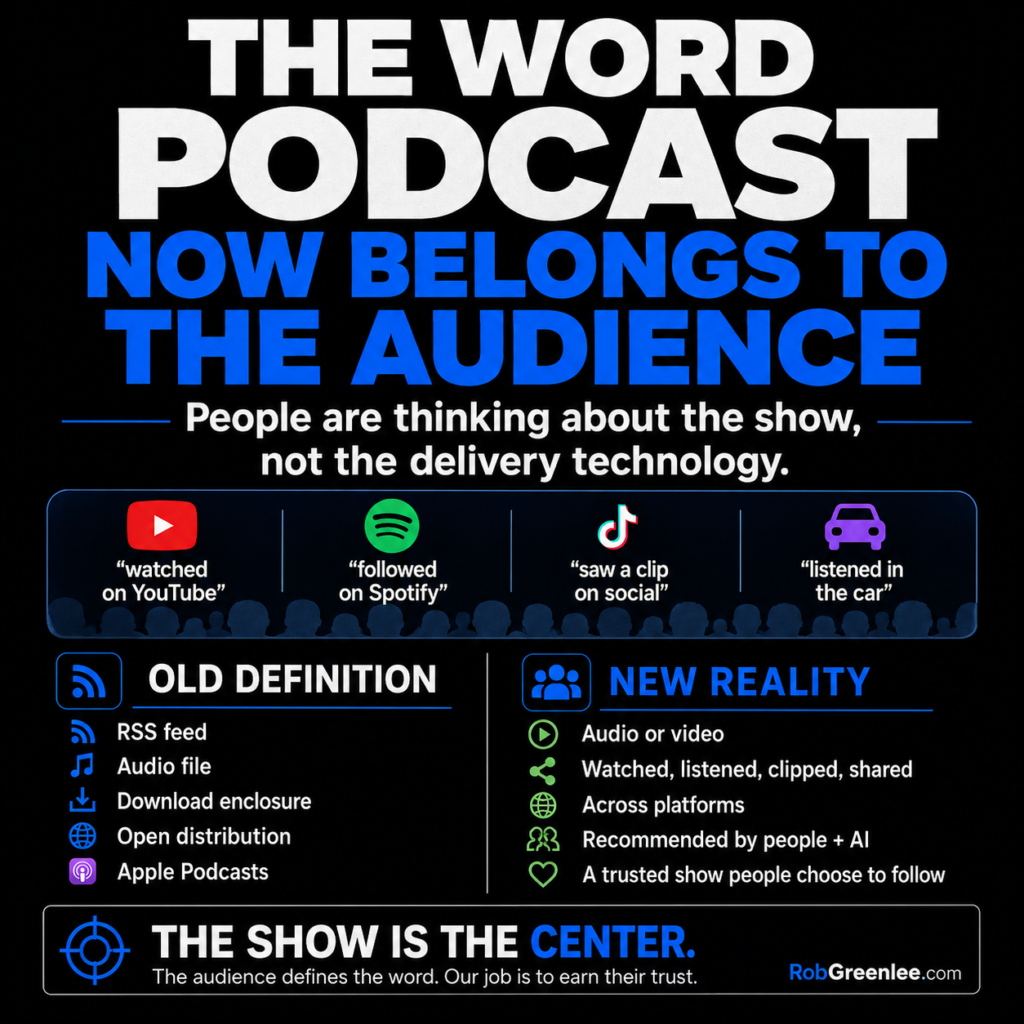
The audience does not care nearly as much about the delivery technology as we do. They say they “watched a podcast on YouTube,” “followed a podcast on Spotify,” “saw a podcast clip on TikTok,” or “listened to a podcast in the car.”
They are not thinking about RSS, hosting platforms, download measurement, API delivery, or whether the file was streamed or downloaded.
They are thinking about the show. That is the shift.
To the public, a podcast is increasingly a recurring show with a host, a point of view, a topic, a relationship, and a familiar format. It may be audio. It may be a video. It may be clipped, streamed, summarized, searched, or recommended by an AI system.
This is where the old industry definition starts to break down.
The podcast industry can argue that YouTube shows are not “real podcasts.” But if millions of people call them podcasts, watch them as podcasts, and advertisers buy them as podcasts, then the market is already redefining the word.
That does not mean open podcasting is dead. It means open podcasting has to compete within a much larger media environment.
The danger is obvious. Platforms want to shape the meaning of podcasting around their own business models.
- YouTube wants podcasts to look and behave like YouTube.
- Spotify wants podcasts inside Spotify.
- Apple wants podcasts inside Apple Podcasts.
- Social platforms want clips.
- AI platforms want structured metadata knowledge and summarized answers.
Each platform pulls the word in its own direction. But the audience is the real force behind the change.
Words follow behavior. Television is no longer just a living room device. Radio is no longer just a local tower.
Podcasting is no longer just an RSS audio file. It is becoming a broader show format.
That means new media creators need to stop building only for the old definition of a podcast and start building for how audiences actually consume media now.
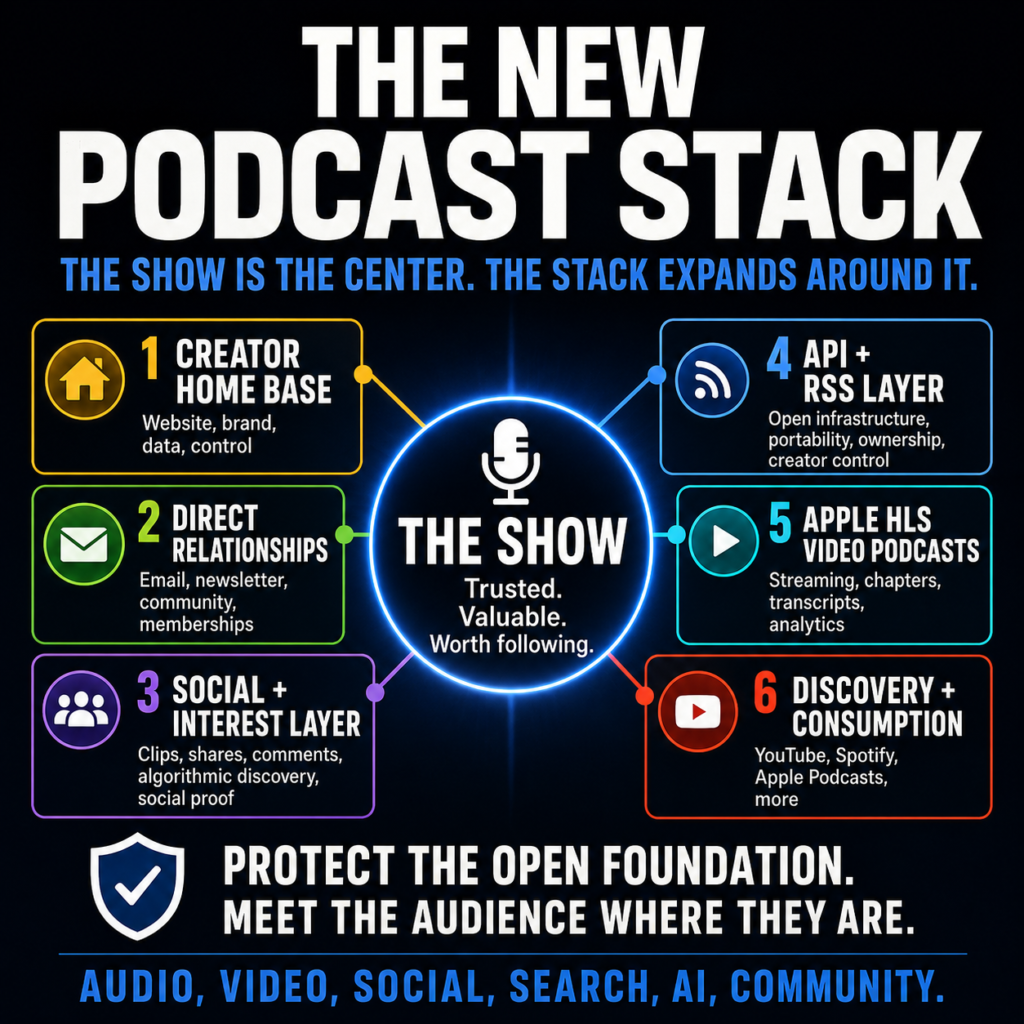
- The show is the center.
- The RSS feed is infrastructure.
- The website is the home base.
- YouTube and Spotify are discovery and consumption engines.
- Social clips are attention triggers.
- Email and community are direct relationships.
- AI search is becoming the next discovery layer.
This is the new podcast stack. The biggest mistake would be to fight the audience over the word. The smarter move is to protect the open foundation while accepting the expanded meaning.
Podcasting’s future will not be won by telling people they are using an incorrect term. It will be won by building trusted shows that work across audio, video, social, search, AI, and community.
The word podcast may have started as a technical, open, but narrow standard distribution term. But today, it means something much bigger. It means a trusted show people choose based on what the platform it is consumed on calls it; if a production looks and sounds like a podcast, then that is what they will think it is in their lives.
And that definition now belongs to the audience.
About the Author
Rob Greenlee is a 2017 Podcast Hall of Fame inductee and Chair, a global new-media leader who bridges podcasting’s human roots and its AI-driven future. As founder of Trust Factor Lab and host of the “New Media Show” and “Spoken Human”, Rob helps creators start, grow, monetize, and future-proof their content. He’s held leadership roles at Microsoft, Spreaker, Libsyn, StreamYard, and PodcastOne, and serves as Chairperson of the Podcast Hall of Fame. Learn more at RobGreenlee.com and join the Trust Factor Lab Creator/Podcast Services.
Personal note: I used AI tools to help organize this article and hand-edited it; the views, clarifications, responsibility, and industry perspective are mine. I have been working in podcasting and platform adoption for more than two decades, and this article reflects my own position. The original word choice was mine, and so is the clarification.