The Word “Podcast” Is Owned by the Audience Now

By Rob Greenlee

Rob Greenlee, 2017 Podcast Hall of Famer, Chair and Host of NewMediaShow.com and Founder of Trust Factor LabFor years, the podcast industry has argued over what a podcast really is.

  • Is it an RSS feed?
  • Is it an audio file?
  • Is it a downloadable media enclosure?
  • Is it open distribution?
  • Is it something in Apple Podcasts?

Those definitions still matter, especially to those of us who helped build and protect the open podcasting ecosystem. RSS matters. Creator control matters. Portability matters. Ownership matters.

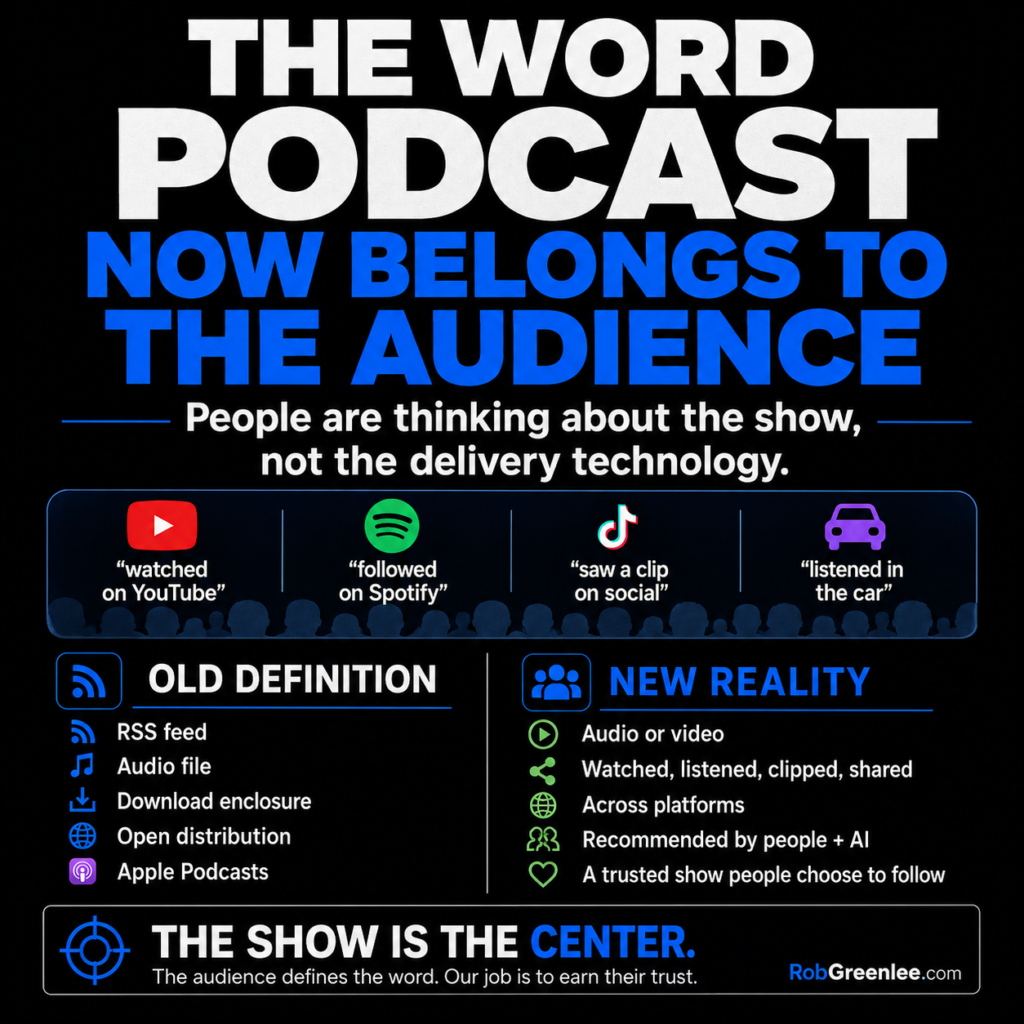
But here is the uncomfortable truth: The word podcast is no longer owned by the industry. It is now owned by the audience.

The audience does not care nearly as much about the delivery technology as we do. They say they “watched a podcast on YouTube,” “followed a podcast on Spotify,” “saw a podcast clip on TikTok,” or “listened to a podcast in the car.”

They are not thinking about RSS, hosting platforms, download measurement, API delivery, or whether the file was streamed or downloaded.

They are thinking about the show.  That is the shift.

To the public, a podcast is increasingly a recurring show with a host, a point of view, a topic, a relationship, and a familiar format. It may be audio. It may be a video. It may be clipped, streamed, summarized, searched, or recommended by an AI system.

This is where the old industry definition starts to break down.

The podcast industry can argue that YouTube shows are not “real podcasts.” But if millions of people call them podcasts, watch them as podcasts, and advertisers buy them as podcasts, then the market is already redefining the word.

That does not mean open podcasting is dead. It means open podcasting has to compete within a much larger media environment.

The danger is obvious. Platforms want to shape the meaning of podcasting around their own business models.

  • YouTube wants podcasts to look and behave like YouTube.
  • Spotify wants podcasts inside Spotify.
  • Apple wants podcasts inside Apple Podcasts.
  • Social platforms want clips.
  • AI platforms want structured metadata knowledge and summarized answers.

Each platform pulls the word in its own direction.  But the audience is the real force behind the change.

Words follow behavior. Television is no longer just a living room device. Radio is no longer just a local tower.

Podcasting is no longer just an RSS audio file. It is becoming a broader show format.

That means new media creators need to stop building only for the old definition of a podcast and start building for how audiences actually consume media now.

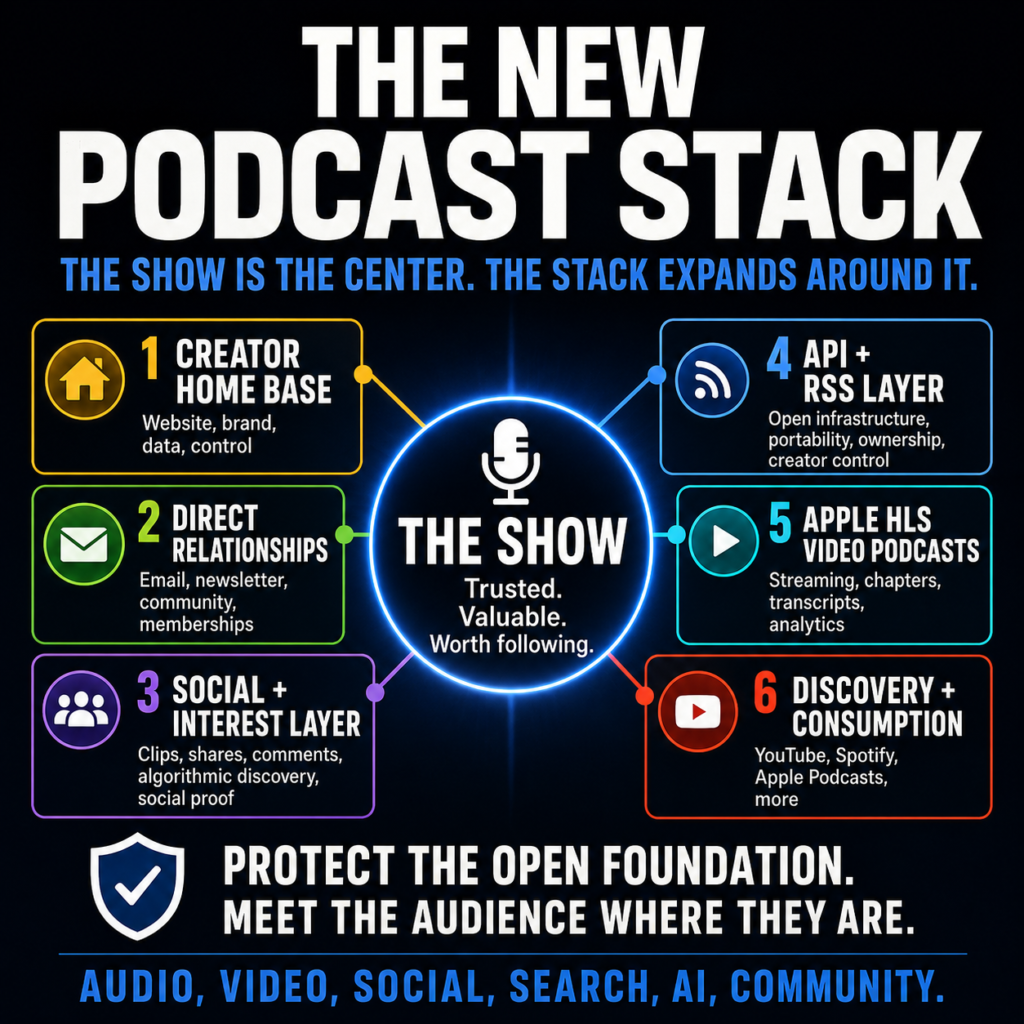
  • The show is the center.
  • The RSS feed is infrastructure.
  • The website is the home base.
  • YouTube and Spotify are discovery and consumption engines.
  • Social clips are attention triggers.
  • Email and community are direct relationships.
  • AI search is becoming the next discovery layer.

This is the new podcast stack. The biggest mistake would be to fight the audience over the word. The smarter move is to protect the open foundation while accepting the expanded meaning.

Podcasting’s future will not be won by telling people they are using an incorrect term. It will be won by building trusted shows that work across audio, video, social, search, AI, and community.

The word podcast may have started as a technical, open, but narrow standard distribution term. But today, it means something much bigger.  It means a trusted show people choose based on what the platform it is consumed on calls it; if a production looks and sounds like a podcast, then that is what they will think it is in their lives.

And that definition now belongs to the audience.

About the Author
Rob Greenlee is a 2017 Podcast Hall of Fame inductee and Chair, a global new-media leader who bridges podcasting’s human roots and its AI-driven future. As founder of Trust Factor Lab and host of the “New Media Show” and “Spoken Human”, Rob helps creators start, grow, monetize, and future-proof their content. He’s held leadership roles at Microsoft, Spreaker, Libsyn, StreamYard, and PodcastOne, and serves as Chairperson of the Podcast Hall of Fame. Learn more at RobGreenlee.com and join the Trust Factor Lab Creator/Podcast Services.

Personal note: I used AI tools to help organize this article and hand-edited it; the views, clarifications, responsibility, and industry perspective are mine. I have been working in podcasting and platform adoption for more than two decades, and this article reflects my own position. The original word choice was mine, and so is the clarification.
2026: YouTube Becomes the Top of the Creator Funnel

By Rob GreenleeGet Help Rebooting or Starting a New Show Podcast here

I’ve spent most of my career living at the intersection of podcast creators, platforms, and distribution shifts. I’ve watched “radio becomes podcasting,” “podcasting become integrated into listening and viewing apps,” and “those apps become more algorithmic-based.”

As 2026 unfolds, I see the next reshuffle getting clearer by the month.

RSS-based Distribution Takes Backseat

YouTube is becoming the top of the creator funnel. RSS for mainly audio, but video could be coming to RSS again soon making it the most important third distribution pathways.

That’s not a knock on RSS. It’s actually a compliment, but the podcasting via RSS industry needs to act fast as we have seen iHeartMedia recently announce support for video via RSS. This could be just the beginning, but Apple Podcasts really holds the keys to unlocking video podcast via RSS again.

The funnel is moving upstream to video

The creator journey is increasingly starting in a place where discovery is native, friction is low, and context is immediate. That’s video.

YouTube has become the default “proof of life or human” place for a show as Live shows become that PROOF. It’s where audiences can instantly sample personality, credibility, chemistry, and production value in seconds. It’s where clips or shorts of human created content travel, but clips are becoming more AI generated. It’s where search and recommendations can do the early real connection and trust-building work for you before anyone ever commits to subscribing.

In the past, you could launch audio-first and gradually build momentum across Apple Podcasts and Spotify with consistency and a decent hook. In 2026, the reality is harsher:

New shows will often need to prove themselves on YouTube before they have much of a chance building a meaningful audio-only audience.

Not because audio is dead—but because discovery has changed to prioritize contents ability to hook and hold on to audience attention or watch and listening time.

Audio-only will still be huge… but for a smaller number of big shows grabbing a huge percentage of the available audio listeners.

Let me be clear: RSS audio isn’t going away. Audio still wins in the home, car, on walks, in earbuds at work, and during daily routines. The audience behavior is real, and the habit is deeply embedded.

But the audio “audience gravity” is concentrating into a smaller number of popular legacy audio podcasts, while the new entry point of priority is creating a video show.

In 2026, I expect audio-only shows via RSS to maintain large audiences primarily among a smaller group of already-popular programs—the brands people already know, the legacy hits, and the breakout franchises that have become cultural defaults.

That doesn’t mean new audio shows can’t win. It means the path to winning is changing and is increasingly connected with video too.

RSS becomes the reliable secondary distribution pathway

Here’s the part many people miss: RSS is still the cleanest, most durable distribution layer in media. It’s portable. It’s open. It’s composable. It’s the pathway that can power hundreds of endpoints or consumption apps without locking a creator into one platform’s business logic.

What’s happening is that RSS is shifting into a role that looks more like this:

  • YouTube drives discovery and “first exposure” and creative discipline to wins with the a
  • RSS supports loyal consumption, portability, and long-term ownership
  • Multi-platform publishing becomes standard, not optional

Creators who understand this will stop treating RSS as the “main stage” and start treating it as the infrastructure—the thing that ensures their show exists everywhere their audience wants it.

Video returns to RSS, but through streaming tech

One of the most interesting developments I expect to accelerate is video coming back to RSS again—but not in the old “download a massive video file” way.

The future looks more like streaming:

  • HLS (HTTP Live Streaming) becomes a more common delivery method for video
  • Feeds expand into separate audio and video RSS feeds
  • More platforms and apps begin to support (or re-support) video feeds as streaming becomes easier and more efficient

In other words: RSS evolves from “just downloads” into a smarter routing layer for audio and video.

That matters because it creates a bridge between the algorithmic world (YouTube) and the owned/distributed world (RSS). It gives creators options. It reduces dependency. It increases resilience.

What creators should do now

If you’re launching or rebooting a show heading into 2026, I’d simplify your strategy to this:

  1. Lead with video for discovery. Design your show so it’s instantly watchable and clip-friendly.
  2. Publish audio via RSS for loyalty. Make it easy for fans to consume anywhere.
  3. Prepare for a dual-feed future. Plan for separate audio/video feeds and a workflow that supports both.
  4. Assume multi-platform is the default. Your “show” is the format; platforms are the outlets.

The creators who win in 2026 won’t be the ones arguing “video vs audio.” They’ll be the ones building a system where video finds the audience and RSS keeps the relationship.

And that’s the real shift: discovery is becoming more platform-driven, but trust and retention still belong to the creators who distribute intelligently.

About the Author
Rob Greenlee is a Podcast Hall of Fame inductee and global new media leader who bridges podcasting’s roots with its AI-driven future. As founder of Trust Factor Lab and host of the “New Media Show” , and “Spoken Human”, Rob helps creators start, grow, monetize, and future-proof their content. He’s held leadership roles at Microsoft, Spreaker, Libsyn, StreamYard, and PodcastOne, and serves as Chairperson of the Podcast Hall of Fame. Learn more at RobGreenlee.com and join the Trust Factor Lab Creator/Podcast Services.


The Truth About Where Podcasting and New Media Really Stand Today

By Rob Greenlee

The truth about podcasting and new media today is clearer yet harder than ever: we’ve crossed a point of no return.

The center of gravity has fully shifted away from legacy media and distribution, old gatekeepers, and the idea that traditional media is the ultimate destination for new media creators.

In reality, the momentum has moved in the opposite direction: legacy media platforms are trying to catch up to the digital creator economy, not the other way around.

Spend a day inside the modern media ecosystem, and you’ll see something undeniable. Audiences now consume content on living-room streaming devices, social interest media platforms, and especially YouTube. They want interactivity, presence, personality, and the feeling of connection that just doesn’t exist in passive formats like cable or traditional TV and broadcast radio. Viewers and listeners want to talk back, participate, react, and feel part of a community. That’s where trust is being built today, and it’s happening at a massive scale.

The real business model of new media creators and podcasting has also changed. The show itself is no longer the final product, it’s the engine. A powerful engine, yes, but one that drives something larger: brands, products, events, memberships, and communities built on trust, interest, and value to the individual. Advertising is still a part of the picture, but it’s no longer the main revenue stream. The most successful creators understand this, and they’re using their shows to build fully formed businesses that extend far beyond creating media content.

At the same time, AI is rushing in fast, bringing both excitement and anxiety. Some people have already replaced their podcast listening time with conversational AI for value and help with life challenges. Others are using AI tools for research, prep, editing, and even creating whole new formats that didn’t exist before. Whether we like it or not, AI is publishing thousands of episodes a week now. It’s here, and it’s reshaping the edges of the digital medium.

For human creators, this is a moment to double down on what AI can’t replicate: lived experience, emotional nuance, personality, and authenticity. That’s where the long-term value lies.

The bigger question is whether the long standing traditional business model of podcasting is in decline or broken. The answer depends on your perspective. If you’re dependent entirely on ads and operating with legacy-era cost structures, then yes, the economics will feel like they’re collapsing. But if you’re approaching podcasting the way the modern creator class does lean, diversified, platform-native, and audience-first, there’s more opportunity today than ever.

This shift poses a challenge for legacy traditional broadcast media, but not an impossible one. To adapt, they must rethink the most fundamental assumptions they’ve held for many decades. They need to move away from exclusivity and closed systems and meet audiences where they actually are. They must build brands around real people, not institutions. They need to treat YouTube and social interest platforms as core distribution, not secondary windows. And they must embrace AI strategically not as an entire replacement for human creators, but as a force multiplier that can open up new formats that humans would not create and build efficiencies in the creation process.

Most importantly, legacy cable and radio broadcast media must reclaim the value of trust. Trust and relevance is the currency of the modern new creator economy. It’s personal, it’s intimate, and it’s earned one episode at a time. No amount of technology or scale replaces that.

The future of podcasting and new media is hybrid, open, global, personality-driven, and increasingly shaped by AI. But at the heart of all of it remains the thing that has always mattered most: the human voice, mattering to your community and the human story, and the human connection.

And that’s the part of the medium that isn’t going anywhere.

About the Author
Rob Greenlee is a Podcast Hall of Fame inductee and global new media leader who bridges podcasting’s roots with its AI-driven future. As founder of Trust Factor Lab and host of the “New Media Show” , and “Spoken Human”, Rob helps creators start, grow, monetize, and future-proof their content. He’s held leadership roles at Microsoft, Spreaker, Libsyn, StreamYard and PodcastOne, and serves as Chairperson of the Podcast Hall of Fame. Learn more at RobGreenlee.com and join the Trust Factor Lab Creator/Podcast Services.

The Future of Podcasting Isn’t Just Video — It’s Format Flexibility

By Rob Greenlee

In the world of podcasting, the conversation too often turns into a binary: “Go video first” or “Stick with audio.”

But the truth is, the future isn’t about choosing one over the other—it’s about flexibility, adaptability, and understanding how both formats can work together to serve your content and your audience.

Video has become a powerful tool for discovery, growth, and monetization. Platforms like YouTube offer unmatched reach and the kind of revenue potential that audio platforms still struggle to match. But that doesn’t mean you have to abandon audio.

In fact, many of the most successful shows today are finding their stride by thinking hybrid from the start—creating content that sounds great and looks great.

Here’s something I’ve observed: transitioning from video to audio is much easier than the other way around.

A high-quality video recording can easily be repurposed into a compelling audio podcast. But converting a pure audio show into something visually engaging for video audiences? That takes more thought, more planning, and often a bigger creative lift. This is why designing with both formats in mind from the outset is becoming the smart move for creators who want to future-proof their shows.

That said, audio-first is still incredibly powerful. Podcasting began as an audio medium for a reason—it’s intimate, portable, and deeply engaging. Millions still tune in daily to audio-only shows while driving, walking, working, or relaxing. That connection isn’t going away.

The key is not to treat audio as a secondary format, but to find ways to enhance it with visual assets—clips, promos, companion videos—when it serves your content and audience.

For video-first creators, the opportunity is huge, but there’s a responsibility too. Just because your show looks great on screen doesn’t mean it’s ready to succeed as a podcast. Audio audiences need clarity, structure, and storytelling that works without visuals. Overlooking that can alienate listeners and dilute your message. But when done right?

A video-first show that respects the audio experience can reach audiences in both worlds.

This isn’t a competition between formats—it’s a collaboration. Video with audio. Audio with video. The creators who embrace this mindset will be the ones who stay ahead in a media landscape that keeps evolving.

The path forward in podcasting isn’t about picking sides—it’s about expanding possibilities.